Wednesday, February 16, 2011

J. S. Bach: 6 'Cello Suites - No accompaniment needed


Music is an agreeable harmony for the honor of God and the permissible delights of the soul.
– J. S. Bach

            A few days ago, I stated “Aside from the piano, there are very few instruments capable of carrying an entire album unaccompanied and without dubbing multiple tracks.  Guitar is one of them…”  I didn’t expect to eat my words quite so quickly, but here I am doing just that.  While not an album in the strictest sense of the word, this instead is a collection of six complete suites for unaccompanied violoncello.  And despite the fact that double and triple stops are so much les frequent on the bowed strings than the plucked, there feels like there are fewer elements missing here.  Yet another testament to the greatest composer in Western musical history – the genius of J. S. Bach.
            Perhaps the most readily recognizable theme for the instrument, the prelude to the first suite sets the example for the movements to come – a strong sense of bass line, harmony and melody, (the second of which is implied more often than stated).  I think one of the things that makes Bach’s writing more successful than Pass’ work is the simplicity of the (oft implied) vertical structures.  Jazz by it’s nature relies on complex chords with extensions, alterations, and individual voicings.  Classical pieces such as this can easily sit on one chord or tonality for 16 bars or longer at a time.  (This is again in no way meant to downplay the virtuosity of Joe Pass and his album, of course.)
            One thing that does seem to get lost frequently is a sense of rhythm.  Some of it I think is due to the expressive nature of the performance, and some of it due to the lack of metrical structures heard by the listener.  (Again, the prelude from the first suite is an exception to this rule.)  However, this “beatless” feel isn’t always a bad thing.  It lends a certain timeless quality to the music, much like chant or other early music.  The melodies wash over the ear as a stream of sound, not individual measures or chunks of ideas, but as one continuous musical expression.  Again, a significant difference between Baroque practice and more contemporary music.
            My understanding of the suite form I confess is somewhat lacking – I really have no clue as to what structurally separates an Allemande from a Courante, or a Sarabande from a Bouree.  I know they’re all dance-based forms, but at this point, somewhat indistinguishable to me personally.  Ironically, this confuses the issue of rhythmic based forms, because tempo and meter are typically the foundation of such pieces.  (See also bossa nova, waltz, tango, etc.)  I guess this is one of those collections I’m going to at this point at least, resign myself to appreciating without theoretically tearing apart first.  And I’m definitely okay with that.

Tuesday, February 15, 2011

Songs in the Key of Life - Music to Live By


2/15/11 – Songs in the Key of Life (Stevie Wonder)

Life has meaning only in the struggle. Triumph or defeat is in the hands of the Gods. So let us celebrate the struggle!
- Stevie Wonder

            This is another album on the list of recordings I knew of significantly better than I knew.  This magnum opus of Wonder has been an influence on so many artists, not just musically, but spiritually as well.  From its blatant socioeconomic commentary to deep religious roots, it follows in the footsteps of Marvin Gaye’s What’s Going On.  A huge two-plus-record undertaking, the volume if this great collection does in no way dilute the power of the music contained herein.  Let’s take a look.
            The accapella opening to “Love’s in Need of Love Today” sets the tone for the entire album – gospel-and-soul-infused pop and funk, drawing on jazz and classical influences.  As the album title implies, each song here is a celebration of the joy of life.  Not always the joys of life, but finding grace and beauty in all of it – the lows as well as the highs.  “Have a Talk With God” introduces some exceptionally hard-grooving funk with an almost industrial sound to it, and again, an explicitly spiritual, even religious message that you simply don’t find in most mainstream music nowadays.
            “Village Ghettoland” is the first trough for me on this journey.  The commentary on urban poverty is poignant, but the pseudo-Baroque synthwork is more distracting than appropriate.  I think some of it may just be dating the album, and my perspective may have been different if I listened to this back in 1976 when it was released.  “Contusion” is a heavy rocking funky instrumental playground, showcasing some great studio musicians in addition to Stevie.  It’s interesting to note up to this point that in addition to being a tremendous songwriter, Stevie plays a diverse collection of instruments on this recording.  Like, an incredibly eclectic variety – impressive in its own right but even moreso for a blind musician.
            The first real chart topper on the CD, “Sir Duke” combines Wonder’s funky rhythm section with a killer horn section for this tribute to Duke Ellington and other major influences on the music of Stevie Wonder.  The iconic soli lines are hip to the n-th degree.  Likewise, the eight-note bass line of “I Wish” is immediately recognizable and forms the perfect basis for this fun-loving chart.  Again, the sax and trumpet foursome contribute some amazing hooks to this track.
            “Knocks Me Off My Feet” slows things down appropriately with a ballad with overtones of Carol King (perhaps with a little added caffeinated kick.)  “Pastime Paradise,” while I’m certain I’ve never heard before, was immediately recognizable – it was sampled heavily (to the point I would say stolen) on Coolio’s 1995 hit “Gangsta’s Paradise.”  The lyrics were changed, but the melody, structure, arrangement even are nearly identical.
            “Summer Soft” takes a very jazz-poppy turn for the album with a medium-slow syncopated offering that if I want to find or transcribe and put into my own repertoire ASAP.  It’s a little “American Idol,” but this is a killer forward-driving piano pseudo-ballad that I want to pick up soon… like maybe this afternoon.  So far, the best new find for me on the album (meaning there’s a few I knew to expect greatness from going in.)
            “Ordinary Pain” is a bit of a letdown compared to the level of greatness established on this album – which I’m sure would be a great track on many others.  As previously stated, this album covers a gamut of emotion and life experiences.  Maybe it just doesn’t speak to me where I am now in life, I don’t know.  Regardless the abrupt shift in styles right before the 3-minute mark is stark and at least to my ear, unwelcome.  It’s like this song is really two songs thrown together, and unfortunately I’m not particularly fond of either one of them. L
            “Isn’t She Lovely” is another great and well known tune – a beautiful celebration of his daughter Aisha Morris.  “Joy Inside My Tears” brings back some of the cheesy synth sounds from “Village Ghettoland,” and again is a low point for me, as is the following track, “Black Man.”  While it has some nice funky rhythm work, the tune seems to stagnate.
            “Ngiculela-Es Una Historia-I Am Singing” is another familiar tune which I sang back in my Jazz Singers days at UNT.  Like many songs from that part of my life, I’m more familiar with the arrangement we sang than the original.  Ours was a little more latin jazz than this synth-poppy version, but still a great song.  “If It’s Magic” is another interesting shift – Stevie’s song is accompanied solely by solo harp.  It’s different… maybe out of place, but still ok.  “As” adds the amazing Herbie Hancock and his signature sound to the album, and it another great piece of work.  The closing track of the album proper, “Another Star,” brings in a heavy dose of disco to the mix, and as always, is great writing and arranging alike.  The following four tracks are all bonus recordings… as if the original double LP isn’t enough.  Forgive me for skipping over them in the play-by-play.  Songs in the Key of Life is a tremendous song cycle with not only a number of great works individually, but a composite that speaks volumes on the joy of living.  They really don’t make albums like this any more.
           
Next up – Bach: Cello Suites
Next week – Exile on Main Street (The Rolling Stones)

Monday, February 14, 2011

Beethoven: "Eroica" Symphony #3 - Immortal and Beloved


Music should strike fire from the heart of man, and bring tears from the eyes of woman. – Ludwig Van Beethoven

            Like I said in a post predating the actual “Album a Day” project, I could have easily spent 9 slots on the entire collection of Beethoven’s Symphonies.  I consciously avoided the 5th and 9th, being the most familiar ones and picked one that I knew I should know, but I couldn’t match a theme with the name right off the bat.  Now that I’m listening through it, I recognize it, and now know what to associate the melody to.
            The first movement, naturally, embodies the heroic qualities that give this work its nickname.  Though originally stated in the celli, the theme is a triumphant, bold statement, almost always designated to the French horn sitting over a strong tonic chord.  The brass and timpani get a greater workout than in most symphonic works, particularly of this era.  Beethoven’s music in general, and this piece from his “middle period” in particular, combine practices and aspects of both the waning Classical period and the Romantic period just starting to come into its own.  While the timbres and textures seem more often than not classical in nature, the harmonic language seems often to stretch forward toward the romantic.
            While not as iconic as the valiant 1st movement, the somber 2nd movement is equally emotional and contains many of the same qualities of the first.  The darkness that encompasses this slow funeral march cracks briefly as the development switches to a relative major, but its return is more satisfying.  The piece laments, often at the top of its lungs – never out of anger, but out of anguish.  It’s no wonder that it was such a popular piece at funerals for heads of state and the like… until Samuel Barber and his Adagio for Strings came along that is…
            The relatively short waltz-y 3rd movement almost feels like an intermezzo – not connected much to the two previous movements to the point it feels like an interruption.  On its own merits, it’s a bouncy little piece propelled by a rhythmic string section , more of a throwback to the classical era than a precursor to romanticism, but fun and delightful nonetheless.  Actually, come to think of it, it breaks up some of the drama from the 2nd, so perhaps it isn’t as out of place as I originally thought.  The levity it brings to the table actually works well.
            The final movement starts off more or less where the third leaves off – with an interesting pizzicato introductory theme followed by some light two voice contrapuntal theme and variations.  As Beethoven plays with the simple theme, it develops into the same dramatic fashion and flair that were so predominant in the opening movement.  The final coda brings that passion and fire up another level.  While the orchestration used here is not too extremely creative, his thematic and melodic elements reinforce the stately nature of this “heroic” work.
            In conclusion, it is fascinating to look at Beethoven’s middle works from a purely academic standpoint – it’s like watching an entire shift in the western musical world occurring all at once.  This piece has elements of brilliance that supersede its classical roots, but does not quite develop into the next step.

Tomorrow – Songs in the Key of Life (Stevie Wonder)

Sunday, February 13, 2011

Virtuoso - I couldn't agree more...


2/13/11 – Virtuoso (Joe Pass)

Jazz is an intensified feeling of nonchalance.
- Françoise Sagan

            Aside from the piano, there are very few instruments capable of carrying an entire album unaccompanied and without dubbing multiple tracks.  The guitar comes close more often than most, but hardly ever to this level of success.  Joe Pass’ album Virtuoso is a tremendous display of… well, virtuosity, elevating the guitar as complete instrument to new level.  From the opening notes of “Night and Day” through the final tones of “The Song is You,”  Pass’ unadulterated, unprocessed solo guitar is the only thing you hear, carrying melodies, accompaniment, bass lines, and countermelodies with uncanny ease.  His guitar sings expressively and bops hard like a sax at other times, but is always a complete package on the melodious ballads and uptempo swings as well.
            Not having the huge jazz repertoire (yet,) I occasionally get lost in some of the pieces – perhaps the sole casualty of the unaccompanied opus.  While things like harmonies and bass tones aren’t constantly necessary, their occasional absence leaves the occasional hole.  Naturally, I find this more noticeable on tunes I don’t know as well, such as “Stella By Starlight” and “My Old Flame.”  The more familiar tunes I’m more apt to mentally “fill in” with my inner ear.  On that note, this is most definitely worth giving another listen to at the end of this project once my library of jazz works is more complete.
            While it’s difficult to distinguish where some of the “tune” ends and the solo begins, Pass’ machine gun precise technique is present throughout.  Specifically, his rendition of “How High the Moon” is a tremendous display of both artistic musicianship and masterful technical performance.  Likewise, the burning opening to “Cherokee” is a testament to the skill and artistry of this phenomenal performer.  “Sweet Loraine” may take the prize as the top ballad of the recording
I know I’m starting to sound like a broken record, but there’s not much else to say.  There are no great variations in timbre and texture, nor significant texts to examine.  Just a master of his art and his instrument.  Not that I mind – I prefer unaccompanied Pass to Django’s stylings by far – there’s just not much to discuss.  Reading a bit about Joe’s musical background, there are a few things that particularly ring true to me – take for example the idea of filling time; using the space between melodic notes to fill out the chords and create counterlines.  Growing up as I began to improvise, I used to do something similar – challenge myself to keep a constant stream of sixteenth notes going so there was a sense of constant motion.  Mind you, I wasn’t even into my teenage years yet, so the result didn’t compare at all to what Pass accomplishes here, but the same idea was there.  (I also wonder if that put him into a “does not play well with others” category… I find that while I worked so hard to be self-sufficient, I still to this day have trouble playing in ensembles because I instinctively want to do it all and cover the bass line and as a result end up angering the bassist, fill out all the harmonies and irritate guitarists, double melodies and get in the way of the lead.  Drummers I’m normally fine with. J )

Next week – The Birth of the Cool (Miles Davis)

Saturday, February 12, 2011

Stravinsky: Symphony of Psalms - "Alleluia... Laudaute"


The Church knew what the psalmist knew: Music praises God. Music is well or better able to praise him than the building of the church and all its decoration; it is the Church's greatest ornament. – Igor Stravinsky

            Once again, apologies for changing the schedule if anyone is keeping track – today was supposed to originally be Haydn’s oratorio The Creation.  However, I’m short on time this weekend and not ahead of schedule as I originally hoped I would be and opted to go with a shorter work for today… that’s not in German.  If you were looking for some of my insights into Haydn, either check out last month’s bit on the “Surprise” Symphony, or if you’re looking for The Creation in particular, you may have to wait until November… when today’s Stravinsky was originally scheduled.  Sorry!
            Stravinsky’s use of tonality always fascinates me, and this piece is no exception.  From the use of the octatonic scale to the jarringly simple E-minor chord punctuating the opening of the first movement, his work is constantly both powerful and elegant.  The pairing of the unison lines octaves apart is also simple and cold in a stoic sort of way that captures one’s attention from the onset of the work.  The simple wavering half steps of the melody capture the essence of the text being sung; an anguished cry to God of “Hear my prayer, O Lord, and with thine ears consider my calling.  Hold not thy peace at my tears.” (Psalms 39:13)
            I would be remiss to venture any further without noting one of the particular anomalies of this great choral work commissioned for the Boston Symphony Orchestra in 1930.  Despite the fact that the orchestra had sizably expanded from previous eras by Stravinsky’s time, Symphony of Psalms is written without employing the clarinets and more notably the violins and viola sections at all.  The upper strings, which more often than not are the backbone of the orchestra, are completely absent.  While some would see this as a limiting factor, I believe it freed Stravinsky to explore timbral possibilities in a newer light – by eliminating the “default,” he was forced to create a tonal palate from scratch, if you will.  Furthermore, the pleading character of the first movement in particular lends itself to the more strained qualities of the celli being brought up into their extreme high register.  The man’s a genius – what can I say?
            The second movement begins with a beautiful double fugue throughout the upper woodwinds before the upper voices come in with the text, now from Psalm 40.  The nature of the fugue naturally obscures the text to some degree, but this can be seen as symbolic of the text; “He brought me also out of the horrible pit, out of the mire and clay.”  As the movement develops, the voices find there way “out of the pit,” into a combination of homophonic chorales and unison lines.  The unisons, as Stravinsky was often prone to do, are often stretched out across three octaves and sung with as little vibrato as possible giving it a hollow yet powerful sound.
            The final movement opens with a very exposed choral “Alleluia,” but as opposed to an overblown exuberant exclamation, this is a soft subdued whisper, evoking rather wonder and awe in the presence of the Almighty.  Yet the octave statements of “Laudate” (or “praise”) are darker and more somber in this (once again) very Russian sounding movement.  The largest movement of the three, this one uses nearly the entirety of Psalm 150’s text.  The “Alleluia” motif that comes back often remains unchanged, yet the context is always changing.  I question at times Stravinsky’s restraint throughout this movement.  While the music is beautiful, it seems so striking to pair texts like “Praise him with the trumpet, praise him with the strings and pipe.  Praise him upon the cymbals…” without employing these sounds.  Almost to the point of defiant.  Again, I find it hard to argue with this great master and find his work to be among the best music of the past 100 years, but this one point I don’t seem to come to terms with.
            Again, apologies for the Haydn.  I’m sure it’s a wonderful piece.  Eventually, I’ll come around to it. J

Tomorrow – Virtuoso (Joe Pass)

Friday, February 11, 2011

The Marshall Mathers LP - Commentary on the Commentary...


2/10/11 – The Marshall Mathers LP (Eminem)

Say there's a white kid who lives in a nice home, goes to an all-white school, and is pretty much having everything handed to him on a platter - for him to pick up a rap tape is incredible to me, because what that's saying is that he's living a fantasy life of rebellion. -Eminem

            Although I was somewhat struck dumb when I ran across the above quote, in most ways, I think the man nailed it on the head.  I will admit I have a certain fascination with rap and I think Marshall has me pegged – I’ve never been the rebellious type, maybe because I’m not assertive enough at times to be.  So instead, I experience my rebellion vicariously through the occasional venture into grunge, rap, metal, or whatever.  And while this white kid from the suburbs and a white-bred world sees that, I’m not incredibly ashamed of that.  On the contrary, it’s nice to have the option to turn it off and return to my clean-cut life.  Does that make me a coward?  No, it means I count my blessings.
            The first song of Slim’s that I remember listening to on the radio that made me stop the car and not only listen to the rest of the track before getting out but lingered with me for the next few days at least was “Stan.”  I still consider it one of his most impressive works.  This fictitious collection of letters from a misguided and emotionally unstable fan both provide a dark satirical allegory on the overhyped fanatics who idolize performers, but at the same time reflects upon his own role in pushing the envelope to the point where this behavior becomes nearly inevitable.  The pairing of the first verse of Dido’s “Thank You” is equally ironic and appropriate. 
            “Who Knew” puts Eminem in the position of a Pontius Pilate – washing his hands of his role in the encouragement of abuse, violence, sex, and drug culture.  He takes every opportunity to point the finger instead at lax parenting, poor schooling, the mainstream media, everyone else but himself.  While I (and again, I think most people who actually listen through his words,) understand the point he’s trying to make, Shady fails to provide an alternative and his venom for the system only fuels what he’s supposedly railing against.
            Likewise, “The Way I Am” takes a defiant stance of “you’re going to look at my work and see what you want to see, so why should I argue with you.”  Actually, I’m not sure if he’s railing against his stereotypes or wholeheartedly embracing them.  The argument works equally well on both levels.  “The Real Slim Shady,” arguably the most commercially successful track on the LP puts a little more emphasis on the hook, but I feel less emphasis on the message.  Despite the graphic language (which, by the way, is less… aggressive… than Notorious B.I.G’s) it’s a radio-format friendly tune – catchy to the point of nearing pop.  The backing loops are immediately recognizable, and the chorus is clean enough it makes radio play without edit.  Ironic, that it says so much less than the other pieces on this album.
            Another interesting facet of Eminem’s music is his use of multiple personas.  While they are of course all the same person, “Slim Shady” is not “Marshall Mathers” and neither of them are “Eminem.”  By separating these three and referring to each of them often in the third person, Mathers successfully separates himself from his other “characters” and can at least give the illusion of objectively commenting on himself.  “Marshall Mathers,” “The Real Slim Shady,” “I’m Back,” and “Remember Me” all take different viewpoints on these aspects of his stage persona, to great effect.
            Eminem’s music, particularly the work presented on The Marshall Mathers LP are somewhat of a paradox.  It simultaneously presents a poignant commentary on the mainstream’s portrayal of the urban-rap culture while at the same time reinforcing each and every one of the stereotypes he’s ranting against.  Again, it’s as if he were writing for the demographic described in the opening quote; the ones far enough removed from the projects that they feel they can sit in judgment, but at the same time, out of some twisted sense of morbid curiosity, desires a glimpse into that life.  Or maybe he’s just that good of an artist and poet – that I honestly feel like he’s targeting me.

Next week – Conditions (The Temper Trap)

Thursday, February 10, 2011

Sky Blue - Breathtaking Vistas of Contemporary Jazz Composition

2/10/11 – Sky Blue (Maria Schneider)

Beautiful music is the art of the prophets that can calm the agitations of the soul; it is one of the most magnificent and delightful presents God has given us.
 – Martin Luther

When I set aside the second Thursday of every month for “Big Band” albums, I wasn’t expecting to encounter this.  This is no Duke Ellington or Benny Goodman Orchestra.  This is closer to if Pat Metheny wrote for a jazz orchestra; a cross between the lyrical sensibilities of a great film score, the simple and elegant harmonic treatment I’ve only heard from Metheny before, only on a grander scale.  This is one of those albums that if I heard in high school or my first years at UNT, I would have pursued my Jazz Studies degree either in addition to or instead of Composition.  (Completely disregard the fact that this album came out after I had graduated from college…)  This is definitely “car worthy” – one of the elite albums that gets burned and takes up a position in the car CD changer until the next great one comes along.
The opening track, “The Pretty Road” is beautiful.  Like, to the point I nearly teared up.  The simple recurring melody begins clearly stated on the piano, and is soon joined by wordless vocals (again, very Metheny-esque) and eventually by the whole ensemble before developing into some light solos.  I’m not sure if the majority of it is trumpet or flugelhorn, but it’s a lush, deep tone and some amazingly expressive lines throughout.  Like the rest of the works on this recording, “The Pretty Road” is no minor work.  Each track here is longer than many classical compositions, and is treated as such.  Plenty of space in the writing, time to develop themes, allowing things to pace themselves leisurely, and recapitulations with structurally significant modal or tonal shifts.  These are not mere songs.  These are major compositions.
            “Aires de Lando” is a very European folk-sounding piece, with clarinet and accordion taking the forefront throughout.  The hand-clapping “palmas” through many sections is based in a Spanish/Latin American tradition and add to the generically “world” feel of the piece.  While very relaxed and smoky (which I don’t think I’ve ever used to describe an instrumental piece before,) it’s not one of my favorites on the CD.  “Rich’s Piece,” presumably named for Rich Perry who solos on tenor sax throughout, begins with a very somber saxophone introduction, almost indicative of Coltrane’s “A Love Supreme” with the drone of a bass and very ethereal cymbals behind it.  It continues on in a timeless fashion – never rushed, always contemplative and floating.
            “Cerulean Skies” is the behemoth of the CD – a 22 minute long oeuvre featuring bird calls and some poignant wordless vocal work from Luciana Sauza.  I keep coming back to Pat Metheny, but the pairings so often remind me of his textures, particularly his work with vocalist Nando Lauria.  Both clear and open and yet warm and inviting at the same time.  Absolutely incredible.  Very few composers use the voice this well as an instrument – Sauza almost never takes the forefront but instead adds color to flute, trumpet, and other lines to amazing effect.  As in “Aires de Lando,” the addition of accordion into a jazz inspired setting is intriguing to say the least.  The reedy, straight toned highs of the instrument are so rarely used, but their tone is employed appropriately and fantastically here.  This Grammy Award winning composition is breathtaking.  My only critique is that since it is so spacious in its use of both time and tonal density, it often feels like the piece is winding to a close only to take a turn in another direction instead.  Like a movie with too many denouements, you begin to feel it come home only to be led into a different mostly unrelated plot.  Both stories are wonderfully written and beautifully presented, but they seem like too much when put together in one massive work.
            Interestingly enough, the final track on the album bearing its name is the shortest work on the recording.  “Sky Blue” has a slightly deeper, more melancholy feel than what has come before, with a warm, rich low brass chorale to open the piece.  A melodious soprano saxophone floats above the warmer textures and sings a heartwrenching tune that is more inspiring than most poetry – capturing what words cannot express.  The more I listen to this CD, the more beauty I find within its contents.  And I don’t plan on stopping any time soon.

Tomorrow – The Marshall Mathers LP (Eminem)

Wednesday, February 9, 2011

Borodin: String Quartet No. 1 in A major - French Vanilla


“Respectable people do not write music or make love as a career.”
– Alexander Borodin

            Borodin is one of those composers I admit to having known close to nothing about before listening to these two pieces today.  I had heard of Prince Igor, his opera, and knew it was the basis for the musical Kismet, but that was about the extent of it.  Listening to his string quartets, I both wish I had heard his work before and at the same time, understand why I haven’t.  It is both beautiful and emotive, but these are two qualities that come pretty naturally in the string quartet medium.  (Ok, perhaps last month’s Ligeti string quartet was not the best example to start with.)  It’s a good couple of piece of music, but it’s just a little, I don’t know… vanilla.
That of course isn’t to say it has it’s moments of greatness.  For example, about 9 minutes into the first movement of Sting Quartet No. 1 in A major there’s what sounds like some incredibly intense and really fun pizzicato section.  On subsequent listenings, some of it may be bowed, but I’d have to look at a score I guess.  The melodies throughout are strong, but unlike with a woodwind quintet (again, one of my favorite mediums to both write and listen to,) there is a lack of textures.  The 1st violin carries the bulk of the melodic weight, delegating supporting roles to the lower strings.  In fact some of the greatest moments are when the cello gets to shine, however briefly.
The first quartet breaks a bit from the traditional “fast-slow-fast” three movement form, opting instead to add an additional fast movement after the slower one.  Although there doesn’t seem to be a huge gap between the opening Allegro and the second movement’s Andante.  The latter of the movement develops into some interesting 2-part counterpoint in octaves, breaking up the texture a bit, but as far as tempi go, everything seems to fall into a comfortable medium tempo until the bouncy 6/8 Scherzo of the third movement.
As such, the beginning of the third movement seems like a bumpy ride – not in that it sounds unpolished or is a poor performance, but that each beat feels like a little jolt runs through it.  Perhaps the best moment of the quartet however is the crystalline straight toned harmonics that whistle above the middle third of this movement.  It’s like listening to the sound of tuned bowed glasses – very ethereal and otherworldly.  Borodin could have written an entire movement of this and I would be very, very happy.  Unfortunately, his return to the opening theme seems like a letdown in that it means leaving this beautiful place.  I guess we all must come back down from the mountaintop experiences as well as ascend to them.  (I however, will file this away as something to attempt in the future – an entire string quartet movement written in harmonics.  Borodin meats Jaco Pastorius’ “Portrait of Tracy.”  Could be brilliant…)  Moments like this are the specks of vanilla bean in the ice cream, carrying the analogy a bit forward - just exciting enough to stand out and make the mundane a little more special.
The stark, 4-octave unison beginning the 4th movement immediately evokes a darker, more somber tone than what has gone before.  The final movement goes on to explore more contrapuntal writing than the first three, and the change is appreciated.  However, it all too soon returns to material from the first movement, and while I appreciate the archform, would still have preferred a return to the third movement instead aesthetically.
I had originally intended on discussing both of Borodin’s quartets today, but I confess, this project is wearing me down a bit.  I fully intend on seeing it through to its completion, and hopefully soon getting a few days ahead again, but for now, I’m going to have to stop here.  There’s just not enough hours in the day.  So much good music, so little time…

Up next – Sky Blue (Maria Schneider)
Next week - Bach: Cello Suites

Tuesday, February 8, 2011

Revolver - "my" The Beatles


2/8/11 Revolver – The Beatles

“The Beatles were raw musically, but I think they really had something.”
- Brenda Lee

            Like I said last month, I’ve heard that everybody who listens to music at some time or another goes through a Beatles phase because the variation over time of the Beatle’s style is so wide there’s something there for everyone.  Hard Day’s Night was not The Beatles for me.  Revolver is much closer.  The music is more complex both in the writing and the arranging.  While they’re still all tidbit songs (tightly in the range of 2-3 minutes) there’s more depth in each song here, even though they’re over before some other songwriters would still be getting started.
            While the level of musicianship is drastically higher on this album, the greatest track is the one song on which none of the Fab Four played – “Elanor Rigby.”  Allegedly inspired by a combination of Vivaldi and Bernard Herrmann’s score for Psycho, the string octet is some of the smartest arranging for a pop/rock album ever. Some of the tunes have the same trademark close harmonies, such as on “Here, There and Everywhere.”  While not the most exciting track on the album, it’s still deeper writing than anything on Hard Day’s Night.
Even sleeper tracks are more complex.  For example, “I’m Only Sleeping” is a mediocre tune, but the innovative use of reversed tape on the guitar pushes the boundaries of not only that time, but still has a certain edge to it today.  “Love You To” begins to showcase the influence of Ravi Shankar with distinctive sounds of the sitar and tabla drone dominating this track.  A number of tracks explore complex meter and metrical patterns, such as on “She Said She Said.”  (The guitar work for some reason also sounds sitar-ish on that one, and I’m not 100% sure why.)  And for the most part, it works.  Predating Genesis and other progressive rock bands, they started to do it right.  Their technique, and their writing was equally cutting edge and in some ways, prophetic.
            “Yellow Submarine,” while one of the iconic tracks of the group, never really did anything for me.  The one track where Ringo gets to strut his stuff and sing lead.  Ah well.  Likewise, “Good Day Sunshine” seems to almost be a throwback to their bubblegum pop earlier work, and I’m ok skipping… if it weren’t a mere 2:09 and not worth it.  “Any Bird Can Sing” seems to find a good common ground between the two sounds.  Likewise, McCartney’s guitar chops came a long way by now.  I almost feel bad about most of the disparaging remarks I made about their musicianship earler.  Almost.  I maintain that early Beatles and late Beatles are almost two separate groups that just happen to have the same members.
            “For No One” sound like a precursor to
Abbey Road
– the French horn solo is almost identical to the trumpet part in “
Penny Lane
.”  The style is a little less polished, but definitely indicative of where the band was headed.  On the other hand, “Doctor Robert” sounds like the leftovers on the cutting room floor from “Paperback Writer.”  Two steps forward, and one step back I guess.
            If everyone has their own Beatles to fall in love with, this may be closer to mine.  And I’m not alone – the Rolling Stones Top 500 Albums lists this as #3.  Aparently this is “the” Beatles for a number of others as well.

Next week – Songs in the Key of Life  (Stevie Wonder)

Monday, February 7, 2011

Mozart: Violin Concertos 1-5 - No longer "paint by number"


Neither a lofty degree of intelligence nor imagination nor both together go to the making of genius. Love, love, love, that is the soul of genius.
– Wolfgang Amadeus Mozart

            (NOTE – Once again, today’s posting is more of a reflection than a critical review of the pieces mentioned.  Still, I feel the character of the pieces is expressed here despite any level of detailed discussion on their finer points.)
I occasionally wonder how different my viewpoint on music of the Classical period and specifically Mozart would be different if my first experience with Mozart had been different.  As a piano student of 14 or so, I embarked learning the Mozart piano sonata – the one everybody knows, even if they don’t listen to Classical music; the one theorist point to as the benchmark of Sonata-Allegro form.  The Piano Sonata in C major, K. 545.  I knew the piece, I enjoyed the piece, but as I learned the piece, I became too flustered with the rigidity of playing it correctly.  I mean, I had no problem with the notes on the page – it was the rest of it that got to me.  The trills and ornamentation had to be just so.  The dynamics were as inflexible as the melodies.  I felt, as a performer, there was nothing I could do with this piece; I had no room for interpretation with tempi, the articulations, even the pedaling was dictated by “the rules” of classical period performance practice as they were described to me.  My adolescent pianist was immediately turned off.  Give me Brahms or Chopin instead.  I not only can play their music, I can play with their music.  I can put my stamp on a nocturne and make it mine.  That was totally out of the question here.  It was like I was being told to paint by numbers when I both wasn't very good at doing so, and wanted to paint outside the lines.
            Looking at Mozart today, I can see the beauty in the rigid performance practice standards.  I think in part that I’m capable of looking past them to the “why.”  A good performer of a classical piece, such as the violin concerti here, can take the rigidity out of the “correct choices” and convince you they are his own choices.  He can delight in the slurs and staccatos not because that’s the way they are meant to be played but because he can make you hear the way they dance (as the composer intended) and not draw attention to the minutiae but still revel in it.
            I still somewhat resent classical music for the same reason I hold a grudge against pop music – it sounds so simple that it could just as well have written itself.  Mozart’s harmonies are not complicated, and his melodies are so based in patterns and repetition that one eight measure theme easily spins into a 64-bar exposition.  And yet, a good performer can take that exposition and make you hear the same theme in such different lights that it’s new and fresh each time.
            James Ehnes’ performances here are a perfect example.  His phrasing brings out the natural beauty of the score, and elevates the composer’s intent instead of imposing his own.  The simplicity of the structure then does not bore, but rather seems natural and unforced.  It’s as if Mozart’s composition were a flawless surface of hardwood.  Where my 15 year old self would have struggled endlessly to paint a beautiful piece, Ehnes gently brushes a varnish so that every texture, every grain, every line is accentuated and elevated, not obscured.  If someone 15 years ago had only told me to put the paintbrush down…

Tomorrow – Revolver (The Beatles)

Sunday, February 6, 2011

Mood Swings - Move over, Take 6?!?


2/6/11 – Mood Swings (The Swingle Singers)

Jazz has borrowed from other genres of music
and also has lent itself to other genres of music.
– Herbie Hancock

Ok, so whenever I listen to a vocal jazz group, I admit, I go into it with the preconceived attitude of “this is going to be good, but not up to the standard… Take 6.”  Unless it’s a Take 6 CD, then the benchmark is their Live in Tokyo recording.  This album may move that benchmark.  I’m blown away.
I remember listening to The Swingle Singers in Jazz Vocal Techniques back at UNT briefly, on the one day out of the whole semester devoted to the history of vocal jazz.  (One day was clearly not enough.)  However, it was never mentioned that the group based in Paris was disbanded in1973 and reformed by Ward Swingle in London.  I apparently only heard the original incarnation.  I don’t know if these guys have been so clean and clear since the rebirth, but this is flat out incredible.
The lyric to miles Davis’ “So What” on the opening track doesn’t do anything for me, but they more than make up for it in great big huge brassy, flashy arranging and killer technique to match.  Then, they follow it up with three Jobim bossa novas.  The first, entitled “Surfboard,” is completely devoid of text – all performed on neutral syllables and some great vocal percussion from the group’s bass and baritone.  The lead soprano cuts through with a straight tone the likes of which I’ve only heard from one other singer.  (Shout out to Natalie Fockel, another UNT jocal jazz alum.)  “Insensativez” and “The Girl From Ipanama” both continue with a mix of scat and lyric, in the original Portuguese of course.  The latter adds a verse in English as well.  The reverb is a little aggressive in the mixing, but that’s a very minor complaint… their performances here are unreal.  “Milonga del Angel” continue the latin trend, once again without lyric. 
“A Time For Love” shifts the album into lush ballad mode.  The thick harmonies of the double quartet are both lush and full, but at the same time pristine in their tuning and blend.  Even after the tune shifts into time, and then into full swing (literally,) there’s a richness that belies the eight unaccompanied voices.  I really don’t have anything bad to say about this CD.  Every track is incredible.
A few tracks later, the group shifts into standard swing mode with back-to-back Rogers and Hart tunes – “Have You Met Miss Jones,” “My Funny Valentine,” and “Lady is a Tramp.”  This last one features more soloing than most of the rest of the CD combined, including a great imitation of a harmon-muted trumpet.  (Not sure which member is responsible for it, but it’s spot on.)  Cole Porter’s “Just One of Those Things” is nearly choral with very little vocal accompaniment in favor of vertical writing.
“My Foolish Heart” again is a tune I associate most fondly with Kurt Elling’s Live from Chicago masterpiece.  The Singer’s arrangement is definitely more traditional and plays closer to the tune with some interesting harmonic variations, but I doubt anything can sway be from Kurt’s version.  Likewise, “All The Things You Are” is always in my mind as Gene Puerling’s arrangement for The Singers Unlimited.  Swingle’s arrangement, however, is closer to Puerling here, with a somewhat misplaced swing section in the middle.  “It Don’t Mean A Thing” is a far more subdued chart than either arrangement by The Real Group.  Regardless, they’re more creative with the lyric.  However, their version of “Soul Bossa Nova,” also known as the theme to the Austin Powers movies, is hilarious and a perfect way to cap this phenomenal record.
I was expecting this album to be good.  And like so many others I’ve ran through, I expected to move along to the next thing tomorrow.  Nope.  This one gets burned and joins BS&T, Jaco, and Antje in the car.  I don’t see this one getting old any time soon.

Tomorrow – Mozart: Violin Concerti 1-5 (specific concerto TBD)
Next week – Virtuoso (Joe Pass)

Saturday, February 5, 2011

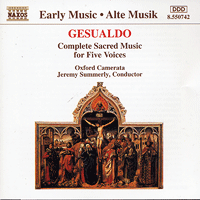
Gesualdo: Complete Sacred Music for Five Voices - Musician, and Murderer


There's a fine line between genius and insanity. I have erased this line.
– Oscar Levine

            The above quote could just as easily have been attributed to composer Carlo Gesualdo, Prince of Venosa, as his life story is almost as fascinating as his music.  His grasp on harmony and shifting tonality is hundreds of years ahead of his time, being compared to the likes of Thelonius Monk moreso than his contemporaries.  His counterpoint that rivals Bach in its elegance, and the sorrow and despair that cries out in his vocal writing is incredibly profound.  Yet as fascinating as his music is, it is nearly impossible to discuss the man without discussing his personal life – driven, according to some scholars, to madness after killing his wife and her lover in cold blood.  It is impossible to say if his music rose to fame because of his crimes or his crimes were a sensation because of his writing.  Either way, the music stands on its own as a true, if tortured, genius of the 16th century.
            Once again, my Latin is not up to snuff to follow most of these individually, so today will be more of an overview of the collection as a whole as opposed to notes on individual pieces.  Gesualdo’s textures are clean and defined – almost entirely free counterpoint for five voices with longer sustained tones in most of the outer voices.  The bass, as usual, defines the harmonies, and the soprano soars above.  The three inner voices have most of the moving lines.
One notable exception is the one piece I’ve performed out of this collection – “O Vos Omnes.”  I remember working on this with None of the Above, the accapella group I joined briefly after moving to Boston.  Here, the writing is more choral, with both the text and harmonies lining up in vertical sonorities than individual lines contrapuntally.  I think in general I prefer the counterpoint, but the homophonic nature of this piece makes it more popular than most of his other works, most undoubtedly because it’s easier to sing and learn.
As I’m sure I’ve noted before, I’m a bit of a stickler for form from time to time.  Most of Gesualdo’s motets are thru-composed, without much return to motifs and melodies from earlier in the piece.  As such, it’s harder to get a sense of form from his work.  Also, there are fewer demarcations of tempo and meter breaking up pieces as was more typical of the time period.  Once again, the music instead lends itself to “washing over” the listener – the counterpoint often obscures the text and the lack of form gives it a timeless sense.  And yet it is intensely beautiful and more complex and awe inspiring in its intricacies than chant.
I think one of the things that fascinates me about Gesualdo as well as other composers of early counterpoint is how their tonality functions on a different level than what we find today, or in the common practice era in general (1750-1900 or thereabout.)  Post tonal music moves outside of the box frequently, but the result is often the same as this “pre tonal” masterworks, written before “the box” existed so to speak.  It’s like how I find my own writing stifled by instinctively following the “rules” of music theory, and how before I knew them, I still worked subconsciously within their framework, but they didn’t govern so strongly what I wrote.

Tomorrow – Mood Swings (The Swingle Singers)
Next week – Haydn: The Creation

Friday, February 4, 2011

Songs in A minor - Great Talent, Hit or Miss Production


2/4/11 – Songs in A minor (Alicia Keys)

I always want to stay focused on who I am, even as I`m discovering who I am.
– Alicia Keys

            “Fallin’” is one of those singles from the brief era that I flirted with mainstream radio.  The repetitive nature of the format of most stations, however, made it a short-lived.  Besides, there were good jazz and Christian stations that I was more apt to listen to anyway.  Still, this single sticks out as one that I would always listen through if it came on before either changing the channel, getting out of the car, or whatever.
            “Piano & I” isn’t as much as a song per se as an introduction to the album.  The hip beat behind Beethoven’s “Moonlight” Sonata reflects Ms. Keys’ approach and background; classically trained but with a bent toward a more “urban edge” sound.  “Girlfriend” pushes more toward the latter, but the canned electronic beats often sound so inhuman and mechanical that it gets in the way of an honest delivery.  I would have liked to hear more piano work.  “How Come You Don’t Call Me” delivers a lot more, although I’d like to hear Prince’s original version of the tune.  Here, Alicia shines more as a vocalist.  Her tone has been compared to Billie Holiday’s, but her range and technical abilities are much more impressive – more in the vein of Christina Agulera’s vocal gymnastics.
            “Fallin’” again is the piece that drew me to both this singer and this album in general.  Despite the simplicity of it’s two chord pattern, there’s great vocal harmonies, both vertically and the cannon-like bridge in the middle of the track.  Simple doesn’t always have to be bad.  Sometimes you can do it well enough it doesn’t have to be anything more.  “Troubles” finally seems to fit into a comfortable soul-infused pop feel that some of the earlier songs seem to have been looking for but not really finding, in my opinion.  Along those lines, I was looking forward to her cover of the great Michael Jackson tune that was to follow, “Rock Wit U.”  Unfortunately, it’s not – just a similarly named piece.  (And not one of the better songs on the album unfortunately.  Double the let down.)
            Interesting to note – the only song in A minor in Songs in A minor is “Jane Doe.”  Aside from this anomalous fact, it’s not an especially remarkable track.  “Goodbye,” however, is a solid R&B ballad with smooth production, subtle artistic synth work, and lush vocals, both at the forefront and filling out harmonically.  “The Life” introduces some light Latin elements with some conga beats and salsa inspired piano riffs, which while completely different from the surrounding tracks, is a welcome addition and an easy fit.
            Alicia’s duet with Jimmy Cozier, “Mr. Man,” keeps some of these same Latin sounds.  At times, however, it feels that it’s more his song than hers – for example, by allowing Cozier to take the first verse completely, it throws the balance of the song off.  Regardless, the chorus is plenty catchy.  Meh.
            “Never Felt This Way (Interlude)” is the first time Alicia’s “keys” are highlighted.  This song, written by the great Brian McKnight, is listed as an interlude, but to me is one of the high points of the CD.  Simply Alicia at the piano for a couple minutes, before transitioning seamlessly and magnificently into the next track.  “Butterflyz” adds a bit of acoustic guitar, but maintains the simplicity of the preceding track.  Where has this been this whole album?  Seriously, better than the tracks that got radio airplay.  Even when the bass comes in halfway through, this is so much more smartly written and arranged.  Restraint once again is key – an adage I need to adapt to my own writing as well.
            I get the impression from this album that Alicia Keys is incredibly talented, but I think the direction of this CD could have gone better.  Those of you who may be more familiar with her works, how does this compare to Diary of Alicia Keys or any of her other recordings?  I’d be interested in listening to more, but not if everything is as overproduced as some of the earlier tracks here.  Perhaps I just need to get my hands on her MTV Unplugged performance…

Next week – The Marshall Mathers LP (Eminem)